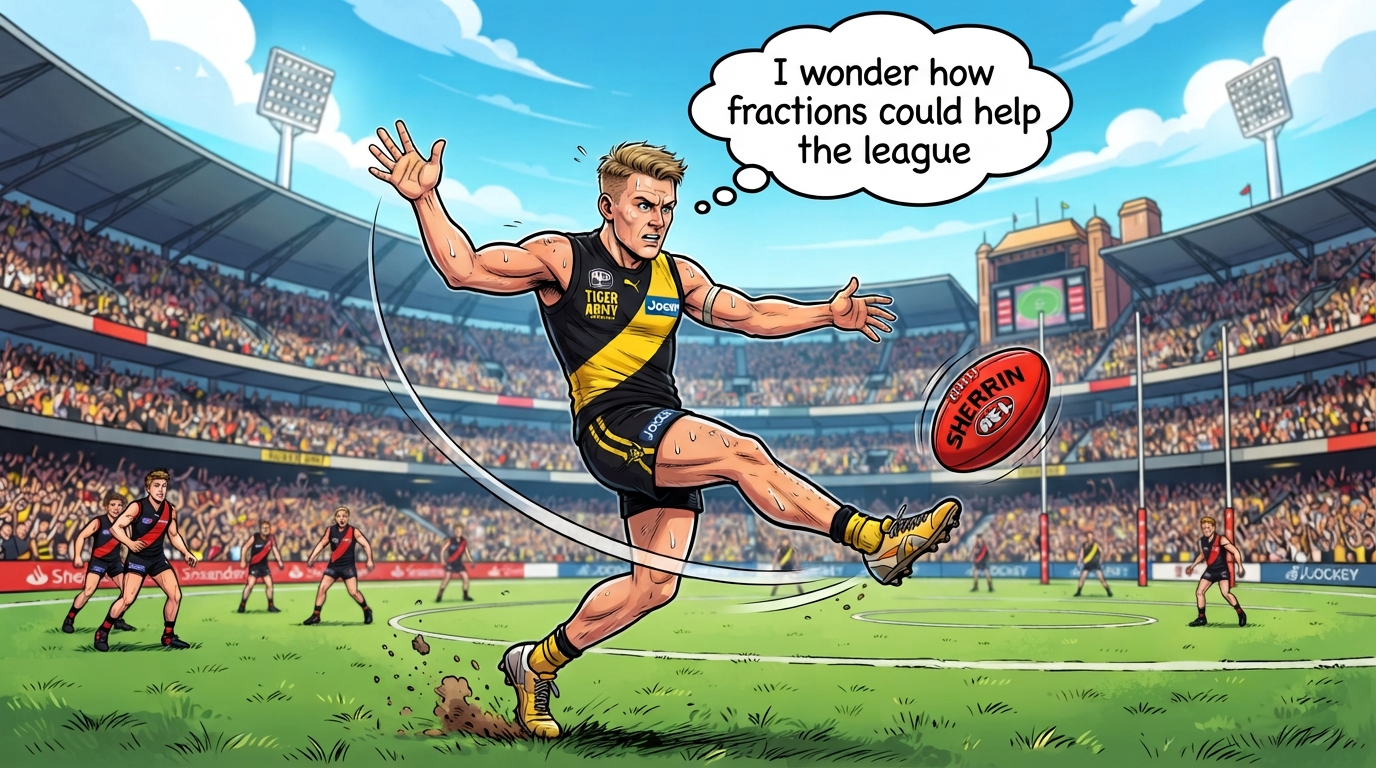
The last two posts discussed fractions. I know that some of you are thinking: Apart from cake-eating contests, where am I ever going to need them in my life? Well, you could march into AFL house, the headquarters of the Australian football league, and declare: “I am here to simplify your points system!”
The curious case of the AFL points system
In the home and away season, each win earns a team 4 points, and each draw 2 points. Now, you would get the exact same rankings if you awarded teams 100 points for a win and 50 points for a draw, or 1 point and half a point, respectively. The point is that, as long as a draw is worth half as much as a win, the rankings will remain the same.
In such cases, mathematicians would choose the simplest allocation, meaning that they would use the smallest whole numbers that would do the job: 2 points for a win and 1 point for a draw.
Before anyone gets nervous about the proposed system changing anything, here is the ladder at the end of the 2026 season, with both scoring systems applied. Notice that the ranking would remain the same under the proposed, simpler system.

Note that I am omitting some non-points related details, such as how two teams on the same number of points get ranked.
What do fractions have to do with this?
Do you know the song, made famous by my namesake, Ziad Turner: “What’ve fractions got to do, got to do with it?” Well, now you do!
The important feature about the current system that must be preserved is this: A draw is worth one half of a win. As we have seen in the first instalment of this series, fractions without tears, one point out of two on offer is the same or two points out of four:

Let’s make the point visually
Figure 3 below shows the points accumulated by a team, after four matches. Each match is allocated a row and each shaded square in the grid represents one point. We could rank the teams by the number of rows they have shaded by the end of those four matches.
In either system, a win results in an entire row being shaded, and a draw in half of a row being shaded. It does not matter how many grid squares are shaded, what matters is the proportion of the possible squares that is shaded.

In conclusion, the AFL ladder would work in exactly the same way if teams were allocated 2 points for a win and 1 point for a draw. This would be a simpler version of the current 4 and 2 points system.
I have a few ideas in mind for the next posts. Let me know if you would like more on fractions, a return to statistics or a maths puzzle.
Leave a Reply