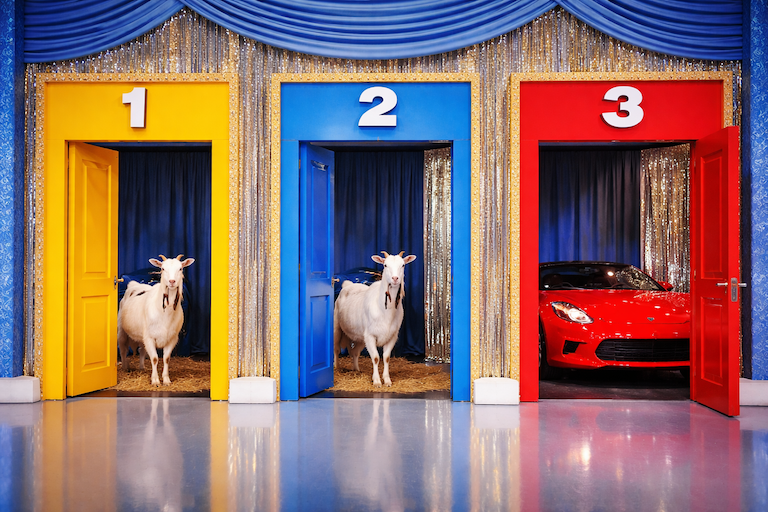
The Monty Hall Problem is a problem that comes from a segment of the TV game show, Let’s Make a Deal, once hosted by presenter Monty Hall. The game, in its mathematically tidy version, goes like this:
There are three closed doors. Behind one of them is a car. Behind the other two is a goat! The contestant, let’s call her Constance, gets to pick a door. Rather than open that door to reveal what’s behind it, Monty Hall opens a door with a goat behind it and gives Constance a choice: Stick or switch. What do you think she should do?
Most people’s intuition, including mine before I sat down to work it out, tells them that it doesn’t matter what Constance does: It is a game of chance, with a 50-50 chance of picking the right door. The reality is that she should switch, as this will give her a 2 in 3 chance of winning.
If you want to skip to the explanation, click here.
Cultural references to the Monty Hall Problem
The problem is covered in the fascinating novel, “The curious incident of the dog in the night-time” by Mark Haddon. The book’s narrator tells us that, when the result was given in a magazine, many PhD-level mathematicians wrote to protest and insist that it wouldn’t matter whether you switched or stuck to your original choice: You are utterly incorrect … How many irate mathematicians are needed to get you to change your mind? E. Ray Bobo, Ph.D., Georgetown University.
The problem also features in the popular comedy series, Brooklyn 99 and The Big Bang Theory.
When you pick the right door
Let’s suppose that, in her first choice, Constance picks the car. Monty Hall will open one of the other two doors. Remember, he knows what’s behind each door and never eliminates the car.

Monty: “Constance, do you want to stick with door 3 or switch to door 2?”
In this case, the Stick strategy wins while the Switch strategy loses.
When you pick a goat
Now suppose that Constance picks door 1. Monty Hall then opens door 2.

In this case, Stick loses and Switch wins.
The exact same thing will happen if Constance picks door 2 and Monty Hall eliminates door 1.

Again, Stick loses and Switch wins.
Conclusion
We have seen that, in 2 cases out of 3, the Switch strategy wins. This is because, at the outset, two doors have a goat and one has a car => Your first guess is likely to be incorrect 2 times out of 3. The game host then improves your odds by taking away one of the wrong choices. Those are the two reasons for you to switch when given the chance to do it.
If you are interested in reading about another case where mathematics contradicts your intuition, take a look at part 1: How many batting lineups for a cricket team?
Leave a Reply