The Cartesian Plane
René Descartes was a seventeenth century French philosopher, scientist and mathematician. You probably know him from the line: “I think, therefore I am!” You may also know that he was the originator of the Cartesian plane that is taught to school kids all over the world.
Legend has it that, one day, Descartes lay in bed, sick and staring at a fly on the ceiling. The fly would move from one spot to another, which got Descartes thinking that there should be a way to describe the location of the fly to the nurse who was behind the room door. This was his inspiration for the Cartesian plane.
The idea behind the Cartesian plane is that we have a central point, called the point of origin, and any dot on the ceiling can be located relative to that point. The fly’s position on the ceiling could be described along two dimensions:
- Its horizontal distance from the central point of the plane
- Its vertical distance from the central point of the plane

Fly 1 is 3 units to the right of the point of origin and 2 units below it. We write its position as (3, -2). The negative sign in the second number says “below the point of origin”.
Fly 2 is 4 units to the left of the point of origin and 2 units above it. We write its position as (-4, 2). The negative sign in the first number says “to the left of the point of origin”.
Symmetry on the Cartesian Plane
When you look at a photo of an object with its reflection in the mirror, you are looking at an example of symmetry: The mirror is in the middle, while the object and its reflection appear to be at an equal distance from the mirror.
We can achieve symmetry by using the two axes of the Cartesian plane as mirrors. Figure 2 below shows a point at coordinates (3, 2) being reflected in the vertical axis. The reflection has coordinates (-3, 2). We then reflect both of those points in the horizontal axis. We now have points whose coordinates have a negative sign in front of their vertical coordinates. These points are 2 units below the point of origin.

Right: Reflecting two points in the horizontal axis.
Symmetry in Native American Art
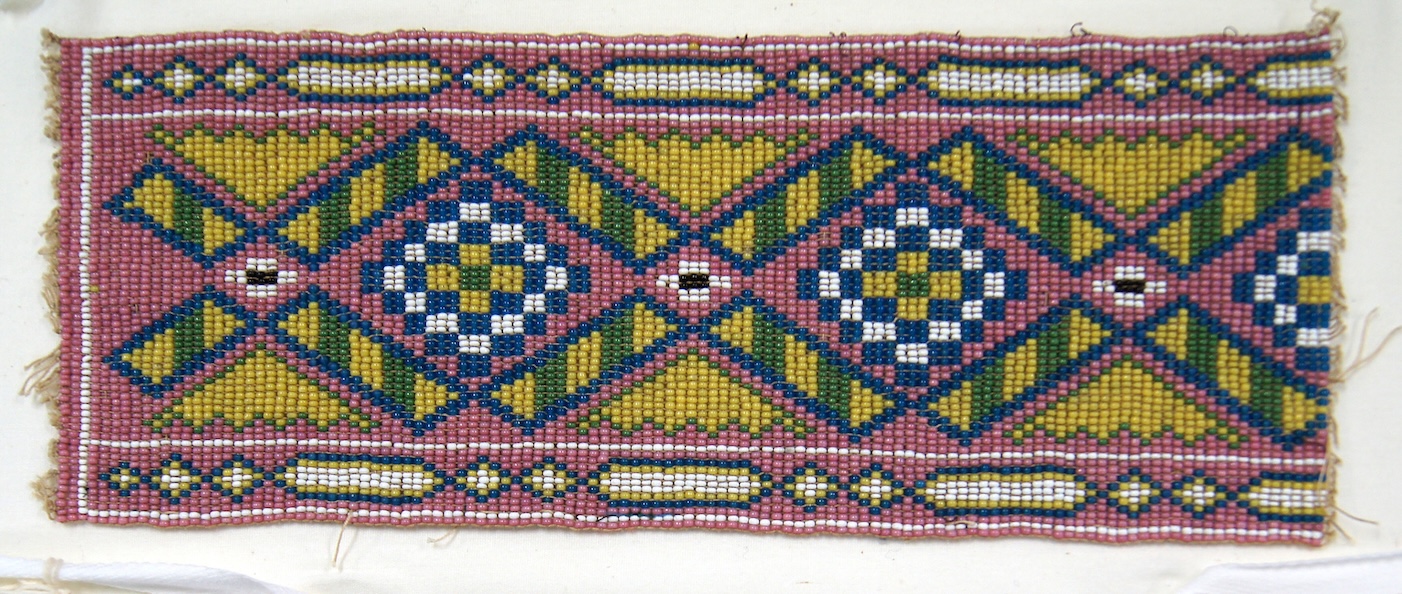
In my teacher education, I was introduced to a website called “Culturally Situated Design Tools”, CSDT. On that site, you can read a short description of the symmetry that can be seen in the artworks of various Native American ethnic groups. In some cases, the tapestries, clothes and bead works show axes in the centre. Even when they don’t, there are many elements of symmetry that can be seen if we divide the artefact into four quadrants. You can see examples of this in Figure 3 below.

You can use CSDT’s virtual beadloom software to produce images of Native American bead works that have the 4-way symmetry we saw in Figure 2 above. Here are the beginnings of a bead work.

Conclusion and looking ahead
In this post, we have seen one example of how mathematics can help us understand the world. We saw how the Cartesian plane can help locate objects in space and how it can help us create artworks that are symmetrical.
Central to this symmetry is the idea of a number line. After all, both of our axes are number lines. Zero is at the centre of any number line and the distance to each positive number is the same, from zero, as to its negative counterpart. The only difference is the direction in which we walk from zero.
While we take both zero and negative numbers for granted, neither was obvious to people for centuries. We may come back to this history in the future. Let me know, in the comments, if this would interest you.


Leave a Reply